


A myth, in my line of work, is just a claim that has outlived its evidence. Sometimes it never had any to begin with. It got repeated enough times, by enough people, in a confident enough tone, that it calcified into something people treat as fact.
Sex toys attract these like almost nothing else. Part of it is that the topic was taboo for so long that misinformation filled the vacuum where good information should have been. Part of it is that a lot of these claims are genuinely useful to someone — a competitor, a moral panic, an anxious assumption that feels safer than curiosity.
So I did what I usually do. I took the ten claims I hear most often, and I checked each one against what the research actually says. A few are flatly false. A couple have a grain of truth buried in a lot of exaggeration. And one or two are worth taking more seriously than the eye-roll they usually get.
Here’s where each one lands.
Myth 1: “Vibrators make you numb — or you’ll get permanently desensitized.”
The claim: Use a vibrator too much and your body stops responding to anything else.
The evidence: This is probably the single most common myth, and it’s largely false. The largest survey work on the subject found that vibrator users reported better sexual function on most measures, not worse — including arousal, lubrication, and desire. [Herbenick et al., 2009, Journal of Sexual Medicine — vibrator use and sexual function] A minority reported temporary reduced genital sensation, but it was uncommon and short-lived, typically resolving within a day.
The truth: Temporary numbness from intense, prolonged stimulation can happen — the same way your hand goes briefly numb gripping something too hard. It passes. There is no good evidence for permanent desensitization. If anything, the data points the other way.

Myth 2: “Using toys means there’s something wrong with your relationship.”
The claim: If you need a toy, your partner isn’t enough.
The evidence: The opposite shows up in the data. Couples who use toys together tend to report higher, not lower, sexual and relationship satisfaction, and they’re more likely to talk openly about sex. Toys correlate with communicative, active sex lives — not broken ones.
The truth: A toy is a tool, not a referendum on your partner. The framing of “enough” is the actual problem here; it treats sex like a test someone is passing or failing. People who get past that framing tend to have a better time.
Myth 3: “Sex toys are only for women, or only for single people.”
The claim: Toys are a substitute for the partner you don’t have.
The evidence: Usage data consistently shows toys are common across genders and across relationship statuses — used by single people and partnered people alike, by men and women. The stereotype simply isn’t supported by who’s actually using them.
The truth: This myth is a leftover from marketing and shame, not from data. Toys are mainstream consumer products now, used most often to enhance sex people are already having.
Myth 4: “All sex toys are basically the same material, so safety doesn’t matter.”
The claim: It’s all just plastic, pick whatever’s cheap.
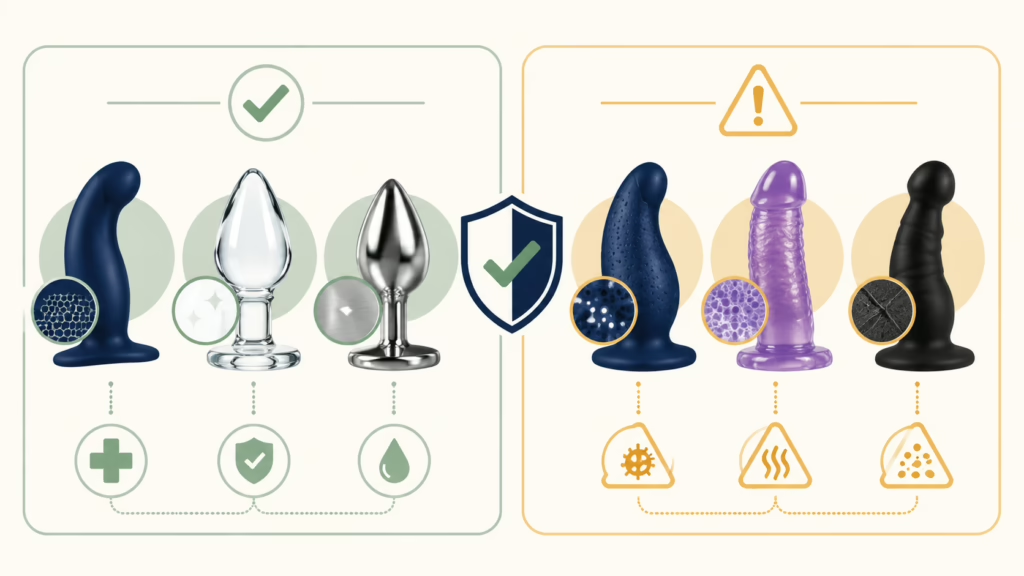
The evidence: This one is genuinely worth caring about. The sex toy industry is poorly regulated, and materials vary enormously. Some cheap toys are made with porous materials or phthalate-containing plastics that can’t be properly sanitized and may cause irritation. Body-safe materials — medical-grade silicone, borosilicate glass, stainless steel — are non-porous and far safer.
The truth: Material matters more than features. This is the one “myth” on the list where the dismissive version is the dangerous one. Buy body-safe materials.
Myth 5: “Lubricant isn’t necessary — and might even be cheating.”
The claim: You shouldn’t need lube; needing it means something’s wrong.
The evidence: Lubrication is a physiological variable affected by countless ordinary things — stress, hydration, hormones, medications, the menstrual cycle, simple nervousness. None of these indicate a problem. Research on lubricant use links it to greater comfort and higher sexual satisfaction, not to dysfunction.
The truth: Using lube is like using sunscreen. It’s not an admission of failure; it’s just sensible. (One caveat the data does support: use water-based lube with silicone toys — silicone-based lube can degrade silicone surfaces.)
Myth 6: “Toys are addictive.”
The claim: Use one and you won’t be able to stop, or you’ll prefer it to a partner.
The evidence: “Addiction” has a specific clinical meaning, and there’s no credible evidence that sex toys meet it. The “you’ll prefer it” claim doesn’t hold up either — as noted, most use is partnered or complementary to partnered sex, not a replacement.
The truth: Enjoying something reliable is not addiction. The anxiety underneath this myth usually has more to do with old ideas about pleasure being suspect than with anything the research shows.
Myth 7: “Expensive toys are just a brand markup — cheap ones work the same.”
The claim: You’re paying for the logo.
The evidence: This one is partly true and partly not, which is why it survives. You’re sometimes paying for branding — but you’re often also paying for body-safe materials, better motors, waterproofing, quieter operation, and quality control that genuinely differs. The cheapest products disproportionately use the questionable materials from Myth 4.
The truth: Price isn’t a guarantee of quality, but rock-bottom price is a reasonable red flag — usually for materials, not performance. Read for materials and reviews, not just the number.
Myth 8: “Men who use or enjoy toys are ‘less masculine.'”
The claim: Toys are emasculating.
The evidence: This is a cultural belief, not an empirical one, so the relevant data is just usage: men use toys, in meaningful numbers, both solo and with partners. There is nothing in the research connecting toy use to anything about masculinity — because that’s a values claim dressed up as a fact.
The truth: This myth does real harm by keeping people from things they might enjoy, purely to defend a stereotype. It deserves retiring.
Myth 9: “You can clean a toy with just soap, or it doesn’t really matter.”
The claim: Hygiene is optional or trivial.
The evidence: Hygiene genuinely matters — improperly cleaned toys can harbor bacteria and contribute to infections. The right method depends on material: most body-safe non-porous toys can be cleaned with mild soap and water, some can be more thoroughly sanitized, and porous materials (Myth 4 again) can’t be fully cleaned at all.
The truth: Cleaning matters, before and after use. This isn’t fussiness; it’s basic body safety. The method matters as much as the act.
Myth 10: “There’s a ‘right’ way to use one, and I’m probably doing it wrong.”
The claim: Everyone else has figured out the correct technique.
The evidence: There’s no clinical “correct technique.” Pleasure is highly individual; what the research consistently supports is exploration and attention over any prescribed method. The anxiety this myth produces — performance pressure, self-consciousness — is itself one of the documented dampeners of arousal.
The truth: The only real mistake is treating it like a test. There’s no audience and no grade.
The pattern underneath all ten
If you read these back to back, you start to notice they’re mostly the same myth wearing ten different coats. Underneath nearly all of them is an old, sticky assumption: that pleasure is suspect, that wanting it plainly is slightly shameful, and that there must be some hidden cost waiting to be paid.
The evidence keeps declining to confirm that. The real, boring, well-supported risks are narrow and practical — bad materials, poor hygiene. Almost everything else on the worry list turns out to be a story we inherited, not a finding anyone measured.
Which is, I think, the most useful thing data can do here: not to tell you what to want, but to clear away the noise that was never true in the first place.
Q: Do vibrators cause permanent numbness?
A: No. Temporary reduced sensation can occur from intense use but resolves quickly; there’s no evidence of permanent desensitization, and studies link vibrator use to better sexual function.
Q: Does using sex toys mean something’s wrong with your relationship?
A: No — research shows couples who use toys together report higher satisfaction and communicate more openly about sex.
Q: Are cheap sex toys safe?
A: Not always. The industry is poorly regulated and cheap toys may use porous or phthalate-containing materials. Choose body-safe materials like medical-grade silicone, glass, or stainless steel.
Are sex toys addictive?
A: No. There’s no credible evidence sex toys meet the clinical definition of addiction.