



In my years as a therapist, I noticed something that took me a while to fully appreciate: the way two people argue about the dishes is usually the same way they struggle in bed. Not the content — the pattern. One person pursues, the other withdraws. One needs reassurance, the other needs space. The bedroom doesn’t create these dynamics; it just turns up the volume on them.
A great deal of that pattern can be traced back to something called attachment style — the blueprint, formed early in life, for how we handle closeness. It’s one of the most useful frameworks I know for understanding not just relationships in general, but the specifically intimate, vulnerable, easily-bruised part of them. And once people recognize their own style, a lot of what felt like personal failure starts to look like something far more workable: a pattern, not a verdict.
Let me walk you through it the way I would have in my office.
What attachment theory actually says
Attachment theory began with research on infants and caregivers, but its more interesting application — the one that’s been studied extensively in adults — is to romantic relationships. The core idea is simple: based on our earliest experiences of whether closeness felt safe and reliable, most of us develop a default way of seeking or avoiding intimacy as adults. Decades of research into adult attachment have mapped how these early patterns carry into romantic and sexual relationships.
Researchers generally describe four broad styles. None is a personality sentence — they’re tendencies, they exist on a spectrum, and they can shift over a lifetime, particularly in the context of a safe relationship. Read these as a lens, not a label.
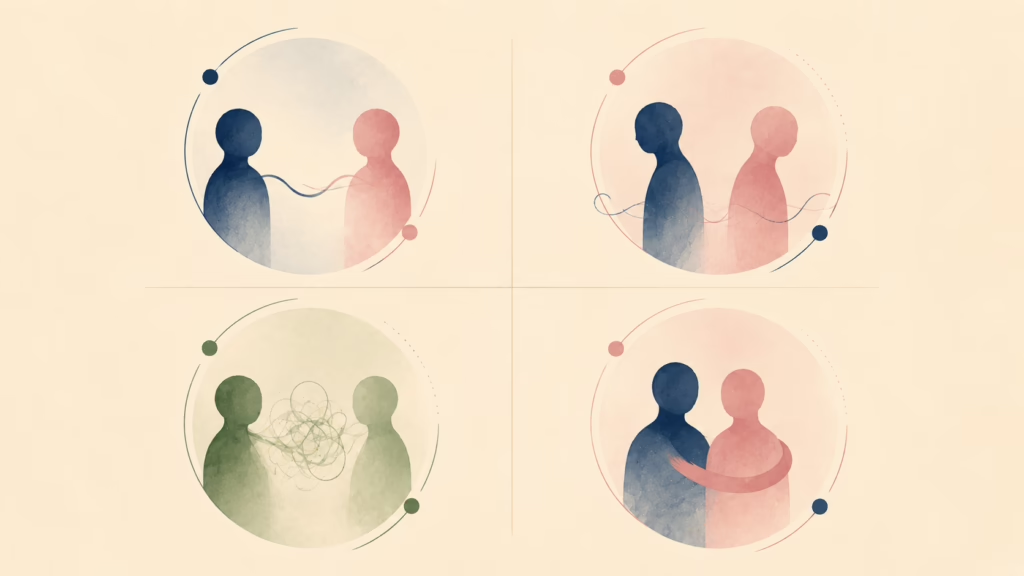
The four attachment styles
Secure. Roughly half of people fall here. Secure individuals are reasonably comfortable with closeness and with independence. In intimacy, that tends to show up as being able to ask for what they want, hear a “no” without crisis, and stay connected without losing themselves. If you’re securely attached, sex is more likely to feel like play than like a test.
Anxious (or anxious-preoccupied). Anxiously attached people crave closeness and tend to fear abandonment. In the bedroom, this can look like using sex to seek reassurance, struggling to voice their own needs for fear of pushing a partner away, or reading rejection into ordinary moments. The deep wish is please show me I’m wanted.
Avoidant (or dismissive-avoidant). Avoidantly attached people value independence and tend to feel crowded by too much closeness. Intimacy can trigger a subtle pulling-back — emotionally checking out during sex, preferring it casual, or feeling smothered by a partner’s bids for connection. The deep wish is let me keep some distance so I stay safe.
Fearful-avoidant (or disorganized). A more conflicted pattern — wanting closeness and fearing it at the same time, often rooted in early experiences where the source of comfort was also a source of fear. Intimacy can feel like hot-and-cold: intense desire followed by a sudden need to retreat.
If you read those and thought “I’m a bit of two of them,” that’s normal. Most people lean primarily one way but aren’t a pure type, and stress tends to amplify whichever pattern is yours.
How styles shape sex specifically
Here’s where it gets practical, because attachment doesn’t stay in the emotional realm — it shapes the sexual one directly.
Anxious attachment is often linked with using sex to secure closeness, which can make it hard to stay present — part of the mind is monitoring the partner rather than feeling the moment. Avoidant attachment is more often linked with a preference for sex that stays emotionally contained, and sometimes with lower interest in the kind of vulnerable, eye-contact intimacy that closeness requires. Studies on attachment and sexuality have found these styles correlate with measurable differences in sexual motivation, satisfaction, and communication.
This connects directly to something we’ve explored before: the way mental state governs arousal. A mind preoccupied with am I about to be abandoned or am I being crowded has its brakes on, regardless of technique. The science of how mental state shapes pleasure is, in many ways, attachment theory playing out in the body.
The pairings: which styles fit together
The question everyone asks is some version of “are we compatible?” The honest answer is more encouraging than the internet’s usual doom about it.
Secure + anything tends to go well. A secure partner is, in effect, stabilizing — their steadiness can gently move an anxious partner toward calm or give an avoidant partner enough room that they don’t need to flee. This is one reason “find a secure partner” is genuinely good advice.
Anxious + avoidant is the famous difficult pairing — common, and combustible. The anxious partner pursues reassurance; the avoidant partner, feeling pressured, withdraws; the withdrawal confirms the anxious partner’s fear, so they pursue harder. It’s a self-reinforcing loop. It is not, however, doomed — it’s one of the most workable patterns once both people can see the dance they’re caught in. Clinical and research literature describes this anxious-avoidant cycle as one of the most common patterns couples bring to therapy.
Two anxious or two avoidant partners have their own dynamics — the former can spiral into mutual reassurance-seeking, the latter into parallel emotional distance — but both are navigable with awareness.
The thing I want to be clear about: compatibility is far less about matching types and far more about awareness. Two people who understand their patterns will do better than a “compatible” pair who don’t.

You are not stuck with your style
This is the part I most want you to take away, because it’s both true and underappreciated: attachment style is not destiny. It’s a learned pattern, and learned patterns can change — a concept researchers call “earned security.” Research on “earned secure attachment” shows people can move toward security through self-awareness, therapy, or a stable relationship.
In practice, movement toward security tends to come from a few things: a relationship that consistently feels safe, the self-awareness to catch your pattern in the act (“ah, I’m pursuing because I’m scared, not because anything’s actually wrong”), and — often — the work of naming these dynamics out loud with a partner. Which is, again, a communication skill more than a sexual one. Learning to bring vulnerable things into the open is most of the work.
How to use this in your relationship
A few things I’d suggest, gently:
Identify your lean, without weaponizing it. “I have an anxious lean, so I sometimes need reassurance” is useful. “You’re avoidant, that’s why you’re broken” is not. The framework is for understanding, not ammunition.
Talk about it outside the bedroom. Naming “when I pull away during sex, it’s not about you — it’s my old pattern” can dissolve years of misread signals. These conversations land best when you’re both calm and clothed.
Recognize the loop when it starts. Most attachment pain comes from the cycle, not the individuals. Couples who can say “we’re doing the pursue-withdraw thing again” mid-moment have already half-solved it.
Give it time and safety. Security is built slowly, through repeated experiences of closeness that didn’t turn out to be dangerous. There’s no shortcut, but there’s a reliable direction.
The bigger picture
Understanding your attachment style won’t, by itself, fix anything. But it does something quietly powerful: it turns “what’s wrong with me” or “what’s wrong with us” into “ah, this is the pattern, and patterns can change.” That reframe — from defect to dynamic — is often where the actual work becomes possible.
We connect the way we learned to connect. The good news from the research is that we can keep learning.
Q: What are the four attachment styles?
A: Secure, anxious, avoidant, and fearful-avoidant. They describe default patterns for handling closeness, formed early in life and carried into adult relationships.
Q: Which attachment styles are most compatible?
A: A secure partner pairs well with any style. The anxious-avoidant pairing is the most challenging but far from doomed — awareness matters more than matching types.
Q: Can you change your attachment style?
A: Yes. Attachment style isn’t fixed. Through self-awareness, a stable relationship, or therapy, people can move toward “earned security.”